12 Point Checklist For Buying Off-Plan Properties In Nigeria
 22, May 2026


Macroeconomic Indicators and Structural Risk Metrics (2024–2026)
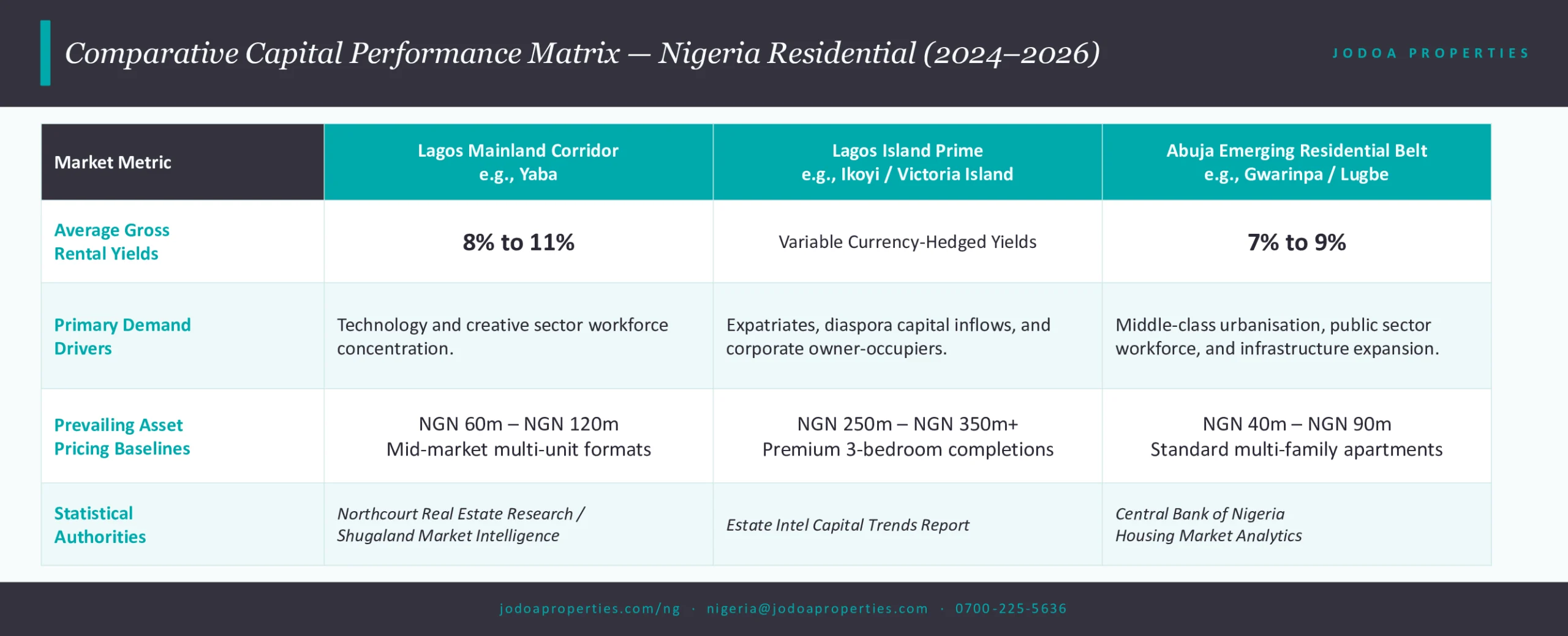
To evaluate the risk-reward profile of the Nigerian off-plan residential sector objectively, buyers must work from empirical data rather than speculative parameters. Market performance across major urban nodes during the 2024–2026 economic cycle reflects distinct operational and structural realities.
GDP Growth. According to the National Bureau of Statistics, real GDP growth within the Real Estate Services sector stood at 3.43% by the final quarter of 2025, whilst the construction sector recorded a year-on-year real growth rate of 5.08%. The Central Bank of Nigeria projects broader economic expansion to strengthen to 4.49% over the course of 2026, driven primarily by service sub-sectors.
Inflationary Pressures on Cost Inputs. Consumer Price Index metrics from the National Bureau of Statistics show that headline inflation peaked significantly during the 2024–2025 period, averaging an estimated 21.26% in 2025. The Central Bank of Nigeria Macroeconomic Outlook targets a deceleration of headline inflation to an average of 12.94% in 2026, a shift expected to stabilise domestic construction cost budgeting and material procurement.
Supply-Demand Matrix. The Lagos State Housing Market Report documents a structural housing deficit of 3.4 million units, representing a 15% expansion from historical 2016 baselines. Data compiled in the Estate Intel Portal Lagos Real Estate Development Pipeline Report tracks approximately 34,800 active residential units under construction, underlining the systemic reliance on formal private sector delivery to address urbanisation pressures.
Comparative Capital Performance Matrix
The 12-Point Checklist
1. Check the developer’s title to the land. Application for Certificate of Occupancy, Governor’s Consent, Deed of Assignment, Excision or Gazette. Ensure the document references the specific land parcel being developed.
2. Make your own title search at the State Land Registry. Do not use the developer’s copy. The search must be carried out and reported in writing by a solicitor acting for you and not for the developer.
3. Confirm that the development and developer are registered. In Lagos, both the developer and the off-plan transaction must be registered with the Lagos State Real Estate Regulatory Authority (LASRERA) pursuant to the LASRERA Law 2021. The developer must also have a valid planning approval from the Lagos State Physical Planning Permit Authority (LASPPPA) and a Letter of Authorisation from the Lagos State Building Control Agency (LASBCA). For other states, check the relevant state real estate regulator and planning authority. Membership of the Real Estate Developers Association of Nigeria (REDAN) adds further credibility.
4. Review the approved construction plan. The plan must be approved by the state’s planning authority and must match the marketing brochure. Heights and density should match unit counts.
5. Check the track record of the developer. Visit at least one completed project by the same developer. Speak to at least two owners who have taken a handover. Note delivery dates against contract dates.
6. Go to the site yourself or send an inspector. Diaspora buyers should require a third-party site inspection report at the time of signing and at each milestone payment.
7. Read the Purchase Agreement carefully before you sign. Note especially the handover date, the late delivery penalty by the developer, the force majeure clause, the termination rights and the forum for dispute resolution. Make sure the agreement or its schedules disclose in writing the annual service charge, sinking fund contribution and the entity that will manage the estate after handover.
8. Ask for a written off-plan indemnity clause. Section 32 of LASRERA Law 2021 states that every off-plan agreement in Lagos must contain a provision indemnifying the buyer against any non-completion or breach of contract by the developer. If the property is outside Lagos, contractually replicate this protection even if it is not statutorily required. The indemnity should specify the timeframe and the security supporting the refund mechanism.
9. Confirm payment routing. Payments should be made to a designated project account, preferably an escrow account at a Nigerian commercial bank or development finance institution. Do not accept cash or personal account transfers.
10. Price is in the currency of the contract. When the naira appreciates, contracts in naira protect dollar earners. Dollar-priced contracts provide a hedge for naira earners when the naira depreciates. The contract should specify which currency applies and how forex conversions are handled at each milestone.
11. Check commitments to infrastructure. Roads, drainage, power supply, water, perimeter security and estate management are often promised in the brochure but absent from the contract. Insist that infrastructure deliverables are described as binding obligations, with their own delivery dates.
12. Keep your own legal counsel throughout. The developer’s lawyer cannot represent you. At each stage, a separate Nigerian-qualified property lawyer should review the title, the Purchase Agreement, the Deed of Assignment and registration documents. Their fee is the cheapest line item in the entire transaction.
A buyer that passes through all twelve steps is not immune from project delay or market downturn. They are insulated from the failures that lead to total loss of capital — and that is the relevant standard.
The Jodoa Property Stocks Framework
The traditional off-plan acquisition structure requires an outright capital commitment over a 24-to-36-month construction window, exposes the buyer to concentrated asset risk, and generates zero yield during the development phase. To address these inefficiencies, investors can utilise Jodoa Property Stocks, which transition the transaction from an off-plan property purchase into direct equity participation within fund-managed developments.
Under this structure, capital is deployed through a blockchain-enhanced property investment marketplace known as Digi-Homes. Rather than buying a physical unit in isolation, the investor acquires shares within a legally distinct Special Purpose Vehicle (SPV) that holds direct title to the underlying development asset.
Cross-Jurisdictional Regulatory Frameworks
Every active asset on the platform operates within a strict regulatory perimeter tailored to its host jurisdiction. In the United Kingdom, investment structures and conduct are aligned with the Financial Conduct Authority (FCA). In the United Arab Emirates, operations are aligned with the Dubai Financial Services Authority (DFSA), with fund administration managed by Apex Group and investment management executed by Dalma Capital. In Nigeria, operations are fully regulated by the Securities and Exchange Commission (SEC) and administered via Afrinvest.
Operational Pathways at Completion
Investors are remunerated proportionally against their equity stake, with distributions drawn from contractual yields, capital appreciation and rental income. At project completion, the structure supports three distinct exit and retention mechanics.
Outright Acquisition. The fractional shareholder retains the contractual option to purchase the entire unit at completion, applying their accrued equity value and intermediate returns directly toward the final purchase price.
Pro-Rata Yield Execution. The investor retains their equity shares post-handover, capturing ongoing distributions from property operations within a managed build-to-rent scheme.
Capital Realisation. Shareholders can exit via a structured sale of the underlying property or access immediate liquidity options via a Peer-to-Peer secondary market integrated directly into the Digi-Homes interface.
Risk Management and Governance
While fractional equity reduces individual capital concentration, institutional governance structures are embedded within the platform. On liquidity, traditional real estate assets carry structural illiquidity. The Digi-Homes platform provides a P2P secondary market, though private SPV transfers remain subject to internal matching timelines and transfer restrictions. On asset management, dividend and rental yields are linked to the operational competence of the appointed asset manager, managed via professional trustee oversight and milestone-linked funding verifications. For investors seeking conservative capital preservation, Shared Investment formats incorporate a full safety shield administered by a regulated third-party Trustee alongside fixed returns and surplus profit shares.
Institutional Track Record
This investment infrastructure is guided by a leadership team carrying over fifty years of combined experience in institutional property development and capital markets across the United Kingdom and the United Arab Emirates. The team’s operational history includes the execution of over £460M in completed transactions and the delivery of more than ten major UK real estate projects. Delivered milestones include the transformation of Quantock House in Taunton under a shared ownership scheme, the completion of Hollies End freehold estates in Mill Hill, London, and the delivery of the Ecos Hotel joint venture in Al Furjan, Dubai.
Aligning with an experienced partner ensures that capital deployment — whether via traditional off-plan acquisition or structured fractional equity — is insulated from systemic operational failures. Jodoa Properties provides the deployment mechanisms, legal structures and market expertise required to secure prime residential assets within the Nigerian market.
Contact Us
Get in touch with our Nigeria office to discuss off-plan acquisition or the Jodoa fractional structure.
Jodoa Properties Nigeria
Oakland Centre, 4th Floor, Plot 2940, Aguiyi Ironsi Street, Maitama, Abuja
Toll Free: 0700-225-5636 (Open 24/7)
Email: nigeria@jodoaproperties.com
 Social Share:







Can Foreigners Buy Property in Nigeria? 2026 Guide
Yes, foreigners can buy property in Nigeria, but rarely outright. Under the Land Use Act, you hold a right of occupancy of up to 99 years, and most international and diaspora investors buy through a Nigerian company that can be 100% foreign owned. This 2026 guide explains the law, Governor’s Consent, the documents to verify, the taxes and fees that apply, and how to purchase safely, even from abroad.
05, Jun 2026
12 Point Checklist For Buying Off-Plan Properties In Nigeria
A complete 12-point checklist for buying off-plan property in Nigeria. Covers title verification, LASRERA registration, Purchase Agreements, escrow payments, and infrastructure obligations — with market data for Lagos and Abuja.
22, May 2026




Nigeria Real Estate Overtakes Oil: A Seismic Shift for Investors
It’s official: real estate has nudged aside oil and gas in Nigeria’s economic hierarchy. According to the 2025 National Bureau of Statistics (NBS) rebasing report, the sector is now the nation’s third-largest economic engine, sitting just behind crop production and trade.
10, Apr 2026